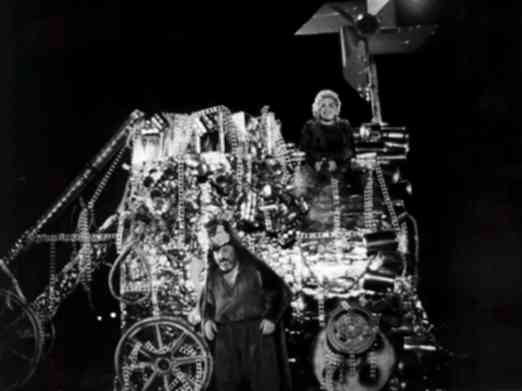
From M. E.’s “Theatre of the absurd”
That movement started on the crucial night of 10th December 1896, when Alfred Jarry “Ubu Roi” was performed in L. P. Theatre “”. It provoked scandal as fiery as the famous battle on the premiere of Viktor Igo’s “Ernani”, 1830 which opened the huge discussion about the romanticism in the French theatre.
Ibi is cruel caricature of one silly, selfish bourgeois, seen through the eyes of a student, but this Rabelais character, Falstaffian greedy and timid is much more than just a social satire. It is frightening representation of man’s animal nature, of his cruelty and roughness. Ibi pronounces himself king of Poland, he kills and tortures with no scruples, and at the end he is expelled from the country. He is evil, vulgar and incredibly cruel, a monster which seemed ridiculously exaggerated in 1896, but in 1945 was far surpassed by the reality. Once more, the intuitive image of the dark side of human nature which the poet presented on the stage appeared to be prophetically exact.
Z. himself more and more accepted
Ibi’s speech, and it appears in few of his later works. In 1899, 1901
and 1902, Z. published “Father Ibi’s Almanacs”, and the continuation of
“King Ibi” titled “Ibi in Chains” appeared in 1900. In this play Ibi comes
persecuted in France and in a wish to be different in the land of the
free people, we turns himself into slave.
(Translated: Eva Markoska Milchin)
Ivan Ivanovski, “Utrinski Vesnik”
Conceptual Performance
“Presenting Jarry’s text on stage, Vladimir Milcin has made reach and
modernly conceptualised production, with fine preciseness of details,
with several inventive solutions ...His performance is analytical and
a result of a deep, creative work. At the beginning of the performance
he makes the actors move like puppets (“Ubi L’roi” was performed for the
first time as a puppet show, and is performed with puppets even now-a-days).
The strongest dramatic point is the tango as a metaphorical sign for the
eternal greed and evil which take man to the ambyss of life… With this
latest work Vladimir Milcin has shown remarkable creative abilities, he
fulfiled the stage with events full of life, with exciting dramatic poetry,
with modern feeling of the grotesque and humour…”
