![]() |
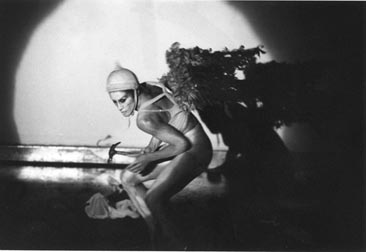
Alchajmer simphony
Reminding herself of the “last Yugoslav event”-
the rally on May 25 1988- when she danced Ravel’s “Bolero”, S. Vukicevic
this time uses the same music for the “alzheimer’s bolero”. With a powerfully
rhythmical dance she develops the “tragic fate," as a stage of the disease,
to neurotic affectation. Inspired by the rising erosion, in the next image
she is dramatically interpreting Kis and makes the ultimate call for sense,
for salvation.
|

| Alzheimer’s disease (AD) is the most common
form of (the so-called cortical) dementia. According to Cummings and Benson,
the disease progresses in three stages. The manifestations of the first
stage are memory disorders (affecting in particular the retention of new
information and memory of recent events); it is shortly followed by the
disruption of judgmental capacity, careless and negligent performance of
professional and domestic duties; the vocabulary becomes poorer; it is
often difficult “to find the right word”; apathy, irritability and suspiciousness
commonly complement the clinical picture at this stage. Progressive memory
loss and disruption of some specific cognitive abilities: aphasia, apraxia,
agnosia and the like are the manifestations of the second stage; the initial
apathy usually develops into psychomotor restlessness, accompanied by frequent
aimless ambling; incontinence is a frequent phenomenon at this stage. At
the terminal (third) stage all intellectual capacities decline (down to
total vacuity); there is a clear motor dysfunction; the body and extremities
are practically immobile in flexed position and there is a pronounced rigidity
of the muscles; incontinence is compulsive at this stage. Death usually
occurs due to aspiration pneumonia, urinary infections or bedsore infection.
|