The wooden book with a macedonian inscription from 5.260 B.C. from the prehistoric lakeside settlement at the Kostur Lake
But,
lets get back to the ancient macedonian substratum. Till now, the oldest
wooden planks with ancient macedonian inscriptions are found in the neolithic
settlement discovered on the coastal hill of the Kostur lake in the village
Dupyak during the archaeological excavations in 1992 – 1994 while
the first researches done on that neolithic settlement were in 1853 –
1854.

The professor of prehistoric archaeology
at the Solun (Salonika) University G. H. Hurmuziadis in 1996 released
a publication on Dupyak from Kostur “(Tó
Disphlió KastoriáV)“ that is “About a lake
prehistoric settlement” ”(¢EnaV limnaíoV
proïstorikóV oikismóV)” where among the
diverse archaeological material, he published an inscription dated and
confirmed with C14 at 5260 B.C. The authentic ancient macedonian inscription
from the wooden plank has the following written form:
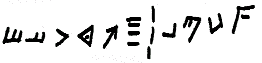
and the same as from in march 1997 from the right to the left deciphered by us and transcribed, it sounds as follows:
“
[UPEL VII KOL'[TE “
“S’PEL VII KOL’STE”
which appropriately transcribed in modern macedonian literary language sounds:
“
[UPEL VII KOLI[TE “
“SUPEL VII KOLISTE”
or
“
[UPLIV, VII
KOLI[TE “
“SUPLIV
VII KOLISTE”
in other words reads
“
DUPJAK VII
KOLI[TE “
“DUPYAK VII KOLISTE”
|
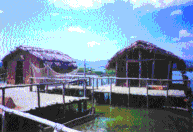
Variants of reconstruction of prehistoric lake site settliment ['PEL (Sh’ pel) of Kostur Lake where is vilage Dupyak close to Rupishta. |
Fisherman’s cabines from the site Kushlakovo at the Doyran Lake are perfect witness for the skill of the prehistoric Macedonians in the period of 8000 - 9000 years
|


This
clearly tells us that the Macedonians in 5260 B.C. knew how to erect lake
settlements with wooden constructions, with objects on wooden platforms
lifted on poles above the wet surface or with other words dwellings on
stakes on the Kostur lake.
Similar prehistoric suburbs in Macedonia were on the Ohrid lake while
in western Europe such settlements are registered in the big lakes of
Germany and Switzerland.
The name of the Macedonian neolithic on pole settlement S‘PEL, the
name of the macedonian village Dupyak as well the name of the ancient
macedonian town Rupishta (Arg) which was the birth place of many rulers
of the ancient macedonian dynasty have the appropriate synonymous base
which emerges from the characteristic relief of the location, that is
from the presence of hollowness or holes, in other words the presence
of caves on the mentioned terrain along the coast of the Kostur lake.
All the three mentioned names are with a macedonian root and their base
reflects the obvious state of the subterranean forms of the morphology
of the area. Following so, Sh’pel, Dupyak and Rupishta have the same
meaning.
|
Exterior look
of the cottages on the Kostur Lake reconstructed in 1998, |
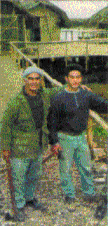
The master
Georgios Haralambidis with his son Niko who had reconstructed
the |