GREAT BATTLES OF THE ANCIENT MACEDONIANS
The oldest evidence of Macedonian written tradition which deal with the wars between the “Zets” of different “Zetas” dates back to the Neolithic period. Perhaps one of the most characteristic written documents of the Macedonian prehistoric chroniclers is the text from Osinchani, near Skopje, which is engraved in a stone in the shape of a long fish. It possesses exceptional semantics and unbelievably compatible and logical compositional arrangement of language and graphic material, and its educative content is as follows:
 |
“ZETOT
UT'\ UEO^O GO ZGAZIL ZETOT STOLE N’D’MSEJ V BOJ E TASOVIOT VUJKO - TOJ, ‘RBETE ‘RXE. ZLOBNI SE.” |
(A battle between
zetas is described, expressing their meanness.)
Wars always brought only harm and misfortune. Many innocent people died
and nothing could compensate the great loss of numberless young Macedonians.
From all pain, the most sensitive was that of the MOTHERS. Dealing with
this is an ancient Macedonian Neolithic inscription from the Tsrna Loma,
or Ilina Gora locality, near the village of Osinchani, close to Skopje.
When deciphered from right to left and transcribed appropriately and translated
into modern Macedonian literary language, it has the following poetical
and philosophical message:
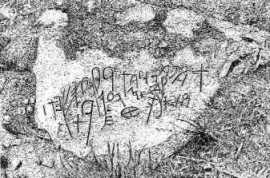 |
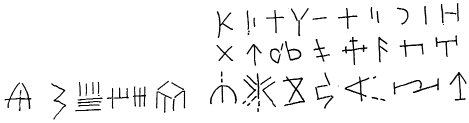
“
TAA, RE^TA, ZASEGA E UTEHA NA MAJKITE, KOI[TO LO[OTO, VOJNATA, NIV GI O[TETI.” |
There is numerous
evidence of the oldest written tradition in the world - the Macedonian.
However, they remain unknown to the greater part of modern historiography.
For this reason the luxurious encyclopaedias and richly illustrated monographic
publications do not contain the oldest evidence of the wars and the actors
in this oldest theatre of mankind. Between BC 2100 and BC 1200 the zet,
IG’LAL boasted that he destroyed the ancient Macedonian empire of
Ege.
|
|
Most probably due to the fact that these and other similar Macedonian monuments to literacy were not published, they allow room for the modern historians and military analysts to claim that the first armoured clash on land between great powers, which determined the fate of the war, was noted around BC 1478 near Megida. It was also said to be the first battle ever that history knows of, the oldest in the era of slaveholding society. According to them, its outcome, as well as the victory of Ramses II near Kadeshite in approximately BC 1295, brought Egypt control over present-day Syria and Palestine. In relation to their consequences, the other battles of the Ancient East are also similar. All available forces are gathered and in the short term clashes the fate of the state is decided even of those such as Babylon in BC 539, near Opis, of Egypt in BC 525 near Pelusi, of Lydia near Pterii, Tembra etc.
|
|
|
|
The iron armor from “The tomb of Philip II Macedonian” found in Golemata Tumba near the ancientmacedonian capital Ege with lovely decorative elements made of gold (IV century B.C.) |
Macedonian helmet from “The tomb of Philip II Macedonian” found in Golemata Tumba near the ancientmacedonian capital Ege (IV century B.C.) |


Almost
every battle at the time was organised and was usually won by the side
that was greater in number, which was better trained, and with a stronger
morale. The main role was played by the archers and spear-throwers, and
later the cavalry and two-wheel carts, who had the task of breaking the
battle line of the opponent.
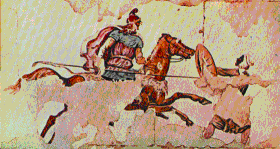
Fresco from the so-called
“Tomb of Kig” (near the town Negus, Aegean Macedonia), which
shows the
Macedonian horseman
As early
as the Trojan War (BC 1193-1183) considered to be the first world war
between ancient Macedonian tribes and followers of the newly come Danais,
with the ancient Macedonians these battles on land represent clashes between
broken up masses of heavy infantry armoured for close battle; light infantry
with weapons for throwing and the cavalry were of secondary importance.
In the beginning the number of soldiers in
the Macedonian state varied between 5,000 and 8,000 infantry and up to
1,000 cavalry. However, with the spread of the borders of the Macedonian
Empire, especially with the reforms of Philip II Macedonian (BC 382-336
King from BC 359 to BC 336) conducted in the Macedonian army, and the
establishment of Macedonian Empiricism, particularly after the fateful
battle near Xeroneia on 2 August BC 338, when the 32,000 Macedonian soldiers
disastrously defeated the 39,000 soldiers of the joint powers of Athens,
Thebes and other Hellenic city-states, already in BC 335 Alexander III
of Macedon (born around 20 July, 356 - died 10 or 13 June BC 323, and
King of Macedonia and the great Empire in the period BC 336-323) had a
Macedonian army of 30,000 infantrymen and 5,200 cavalry. He used his entire
power in the battles on the Granik River (BC334) and on the Pinar River
near the Kilikis city of Is (beginning of December BC333.) In the battle
near the village of Gavgamela (BC331) the Macedonian army already had
approximately 40,000 infantry in the invincible Macedonian phalanx, and
up to 7,000 cavalry, used in the “slanted formation” for a brilliant
victory, defeating the Great Persian Empire of Darius III Kodoman (BC
335-330) and conducting the great exploring expedition to the East.

Potrait of Philip II Macedonian made of ivory and found in the tomb of the Macedonian czar in the so-called Golemata Tumba near the ancientmacedonian capital Ege (IV century B.C.). Thessaloniky, Archeological Museum

Map with the disposition
of the military formations of the Macedonians led by the Macedonian
czar Philip II Macedonian against the combined forces
of the Athenians, Beoties, Tebanties and their allies in the battle
in Heroneja
(2 August 333 B.C.)
On this occasion
we must emphasize that in the battle on the Granik River, according to
Arian, on the Persian side there were 20,000 cavalry and 20,000 Hellenic
mercenaries-infantry from Minor and Great Frigia, Lydia, and Kapadokia.
According to Arian, the Persians lost 1,000 cavalry and 18,000 infantry,
while the Macedonians only lost 85 cavalry and 30 infantrymen. According
to Plutarch, the Persians lost 20,000 infantrymen and 2,500 cavalrymen,
while the Macedonians lost only 34, of whom 9 were infantrymen.
In the battle at Is the Persians had a huge army of 600,000 people of
whom 30,000 were Hellenic mercenaries. According to Plutarch, Darius had
1,000,000 people of whom he left 110,000 dead on the battlefield.
Near Gavgamela,
according to historical sources, Darius III Kodoman had from 60,000 to
80,000 infantrymen, 15,000 cavalry, 200 military carts and 15 elephants,
while on the battle field they lost 40,000 Persians and allies.
Among the more significant and more dangerous battles that Alexander III
of Macedon lead is also the great battle with the huge army at Por. Namely,
in the summer of BC 327 after leaving a powerful army in the restless
Baktria, Alexander III of Macedon once again crossed the Parapamis River
with approximately 40,000 people, amongst which there were many new followers.
In the spring of BC 326, having had conquered the Indus River, he continued
his expedition and conquering of Punjab going towards the Southeast. Near
the Hidasp River he came across serious opposition from the numerous army
of Por. Por (or Pn’ros, POROS, according to other sources, and according
to Indian sources PAURAVA or PARVATAKA) was king of the ancient Indian
state of the central part of Punjab. In BC 326 in the spring battle near
the Hidasp River (Dgelam) headed by the great army, which included many
war elephants, Por as a “…governor of that side of the Indus…”
gave strong opposition to the Macedonian entrance and scientific exploration
of Punjab. Nevertheless, through skillful tactic and use of so-called
“misleading maneuvers” the ingenuous strategist and tactician,
the unsurpassable military leader of all time, Alexander III of Macedon
with only “…one part of his infantry and best cavalry”
he crossed the 900m wide river Hidasp and scored a very difficult but
significant and bright victory over the huge army of Por which had 30,000
infantrymen, 6,000 cavalry, 420 battle carts and 200 elephants. Against
the Macedonians, according to Arian, they lost 20,000 infantrymen, 3,000
cavalry and were dispersed by the invincible Macedonian Phalanx and unconquerable
Macedonian cavalry. In this battle, according to Arian, they lost only
230 cavalry and 60 infantry men.
|
Military equipment
and weapons owned by the Macedonian army found in different regions
in Macedonia |
Fresco which shows the Macedonian javeliner from the tomb on “Tumbata Bela” on the Macedonian tombs in the Ege necropolis (250 - 200 B.C.) |


Respecting his great, clever, fast, and brave rival, the captive and heavily wounded Por asked that he be treated like a “king,” which meant that he be killed. However, the generous and human Alexander III of Macedon treated the Indian king truly like a king: he restored his royal dignity, he returned his previous governing, and even granted him additional land in which, according to Plutarch, there were “…fifteen tribes, five thousand larger cities and many villages” and thus made him a loyal vassal ruler of part of the Great Macedonian Empire, which at the time spanned over a territory of 3.8 million square kilometers. Of course, Por’s ruling was constantly controlled by a Macedonian deputy in Punjab. It seems that after the foundation of the city of Bukefalia, and an entire 9 years after the battle near the Hidasp River, in BC 317 King Por was killed by the Macedonian deputy Evdem. At least this is what sources and military historians say, analysing the huge, inestimable Macedonian contribution to the development of works on war in the world, who opened the doors for spreading of the great Macedonian culture towards the East and throughout the civilized world giving this great Macedonian civilization tremendous opportunities for permanent growth and development with new impulses.